Drama
Participants will be able to apply voice, body, and imagination to portray various characters while engaging in role playing, playmaking, and storytelling.


Drama in the Classroom
Drama in the Classroom
What You Will Find In Drama
Scroll or click through the cards below to navigate content in this section.
Why Drama?
Provides a natural way for children to learn and explore.
Encourages dispositions for teamwork and collaboration.
Brings attention to the whole person, including physical, emotional, social, and intellectual aspects.
Develops imagination, creativity, and critical thinking.
Enhances the ability to express through movement and voice.
Boosts confidence and builds twenty-first century skills.
"I regard the theatre as the greatest of all art forms, the most immediate way in which a human being can share with another the sense of what it is to be a human being." -Oscar Wilde

Drama Vocabulary
Click here to return to the drama menu.
In drama instruction, the teacher helps students not only understand the principles and skills of the art form but also recognize the processes, techniques, and conventions. These various elements often overlap and interact during creative drama experiences. Study the list below to discover ways to integrate drama principles, skills, and processes into classroom instruction.
DRAMA: A conflict, most often in story form, is identified, explored, and performed by actors.
ACTORS: People who portray characters by making creative choices using body, voice, and mind. A group of actors are the ensemble.
AUDIENCE: Individuals viewing the drama, and who will make meaning from the drama.
DESIGN AND TECHNOLOGY: Design elements to be considered when creating a presentation for an audience include scripts, props, costumes, lighting, and sound.
THEATRE: The art of producing and communicating drama for a non-exclusive, invited audience, theatre requires students to develop higher-level performance skills and can include normal plays, such as comedies, tragedies, polished and revised improvisation, and storytelling works, as well as musical theatre, circus, and vaudeville. Ideally suited for older students (upwards of fourth grade), theatre is primarily audience-centric, places the teacher as a director/producer, and includes a formal audience and performing space.
GUIDED CLASSROOM DRAMA: Guided classroom drama is designed to benefit students' own understanding of themselves, help them develop empathy for others, and encourage a deeper understanding of ideas and issues. Storytelling, creative drama, dramatic play, choral speaking, puppetry, process drama, pantomime, narrative mime, theatre games, mantle of the expert, improvisation, and teacher-in-role are examples of guided classroom drama activities. Guided classroom drama is easily integrated into other core curricula, is student-centric, incorporates the teacher as facilitator, and includes a non-formal audience and performing space.
PLAYING SPACE: The physical space where the drama is enacted.
REHEARSAL: The time during which actors, facilitators, and directors investigate, explore, practice, and polish drama work.
SIDE COACHING: A facilitator identifies students' needs and coaches in the moment of creation. Through questioning and suggestion, the facilitator encourages creative stretching, choice-making, and skill development through dramatic responses. Side coaching is also a function of formative assessment.
FACILITATOR: A designer of drama learning, most often the classroom teacher, who encourages creative work through side-coaching.
DIRECTOR: This person facilitates the actors' rehearsal work for theatre and coordinates other theatrical artists/workers.
IMPROVISATION (IMPROV): Also called acting "on-the-spot," improvisation involves using creative intuition to address dramatic conflict.
SCRIPT: The script details the dialogue and directions used to guide the actors. Scripts can be created before actors begin or during actor exploration; scripts can be minimal or detailed; and, scripts can be the result of an individual creation or group collaboration. A script might also be improvised.
THEATRE FOR YOUNG AUDIENCES (TYA): Theatre created and designed for child audiences, like the Utah-based Plan-B Theatre's educational productions, offers a prime example of theatre for young audiences. The stories, issues, design, performance style, and staging are designed to meet specific developmental, educational, and emotional needs of children. Professional, collegiate, and some amateur groups may tour such productions; most will provide core-integrated materials or other classroom enrichment for teachers.
Actors' Tools
Click here to return to the drama menu.
BODY
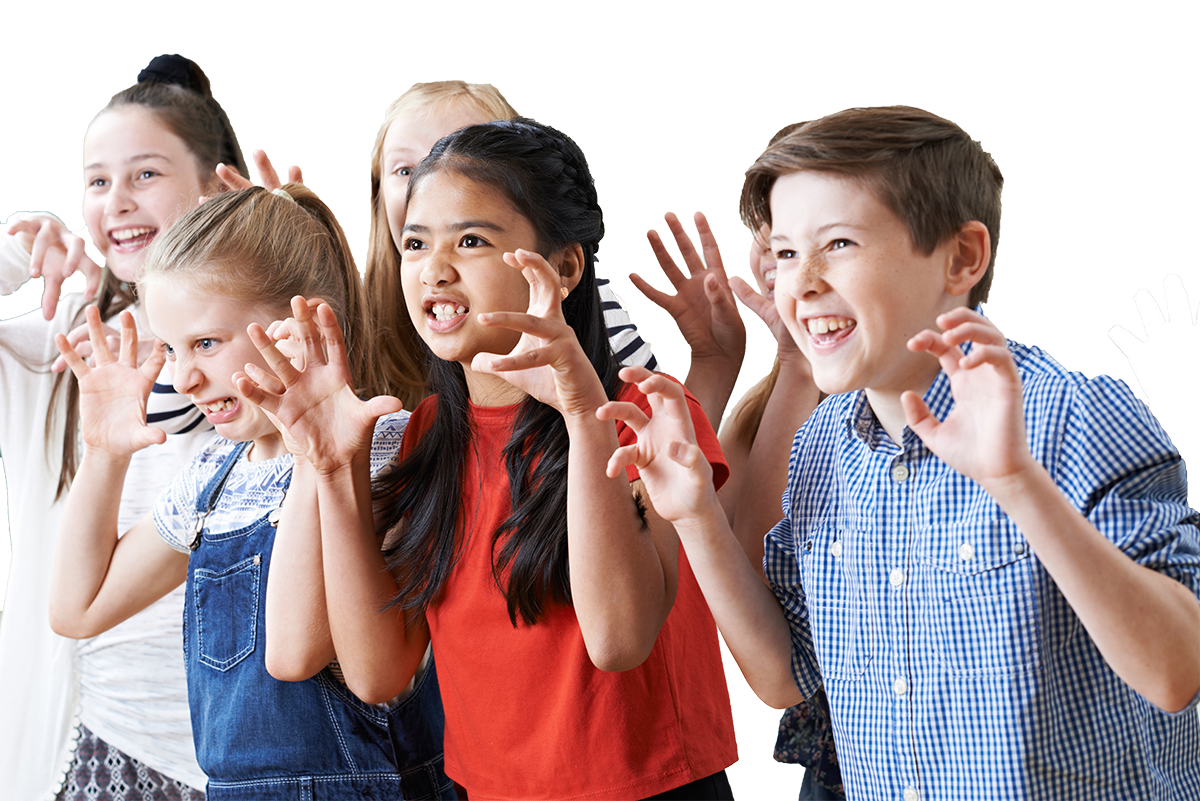
Actors use their bodies to give life and shape to their characters, to move around the space, and to perform skills including dance choreography, stage combat, tumbling, puppetry, and more. Actors use their faces to express the emotions that their character is feeling. Actors' bodies and faces can be used as canvasses for incredible costumes and stunning makeup, or to move fabulous props. Used in tableau scenes to create atmosphere, bodies transform the stage into a living thing.
VOICE
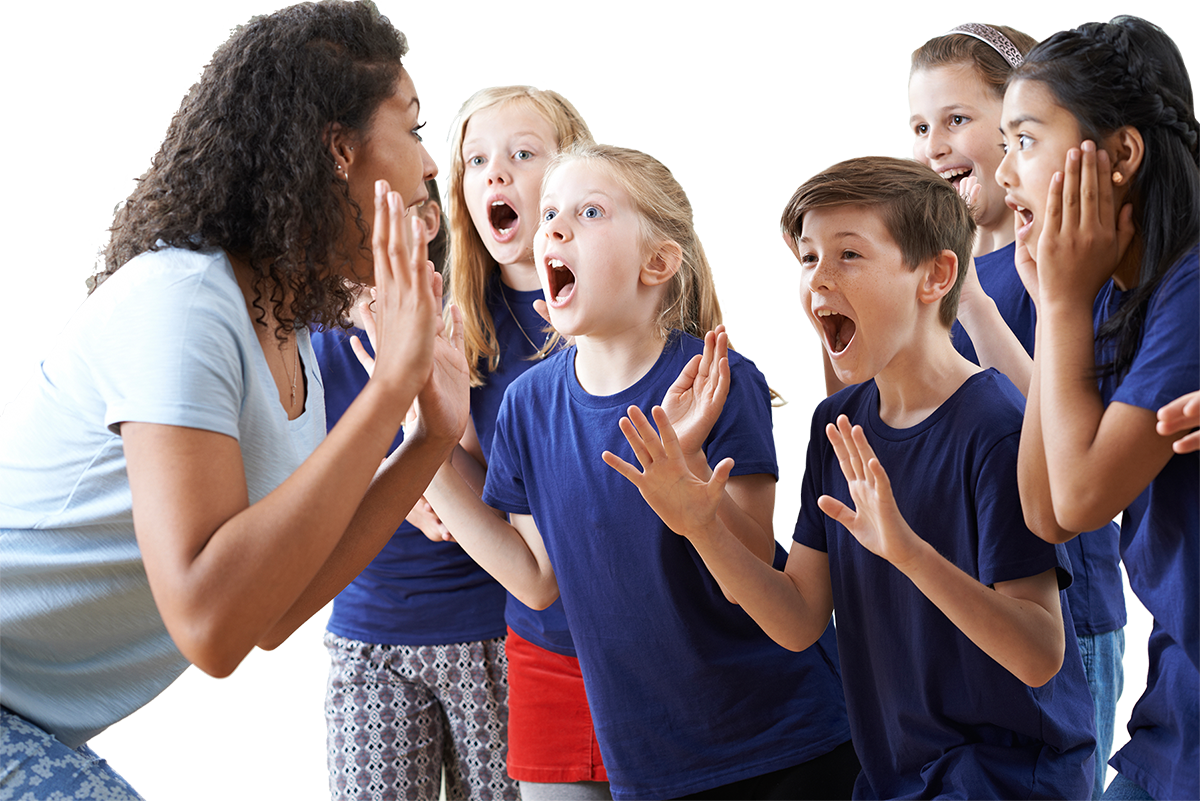
An actor's voice is versatile, expressing the innermost thoughts of their character through monologue or soaring through a gorgeous aria or ballad. Actors can create sound effects and soundscapes through their voices. Used effectively, a whisper or a shout draws in the audience and fully engages their attention.
MIND
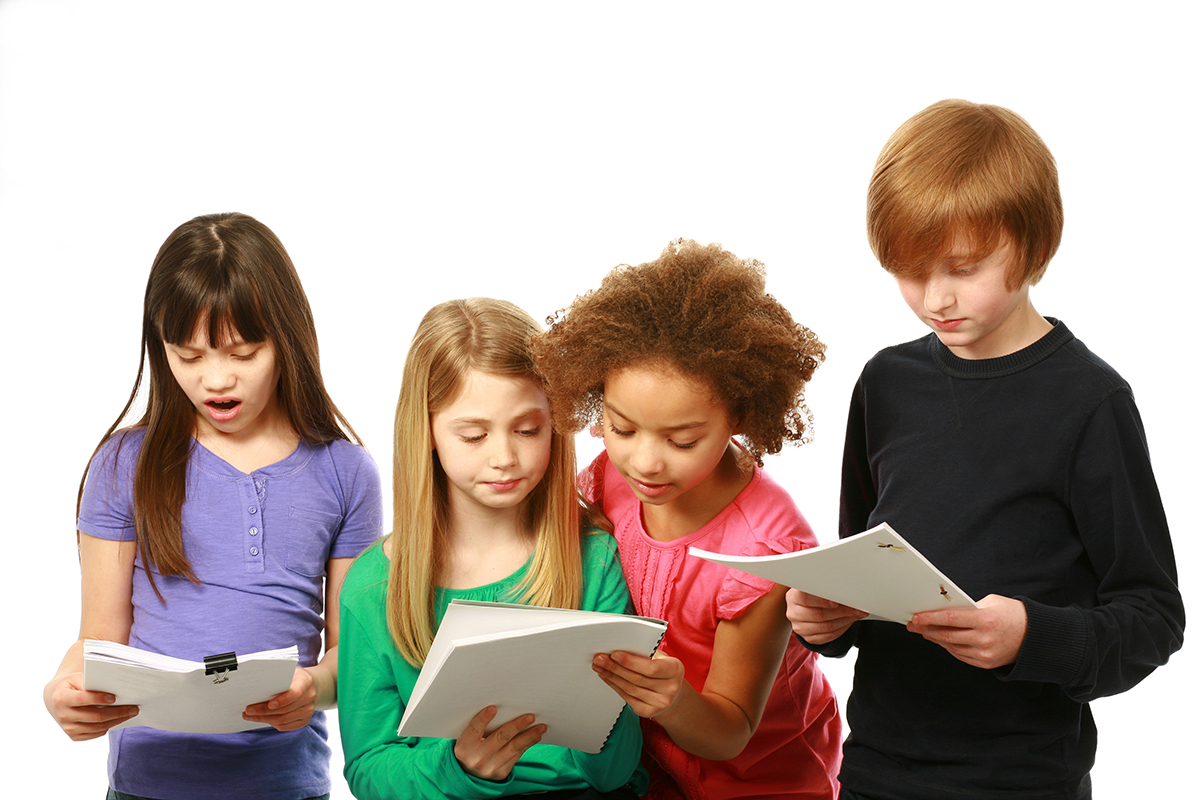
Imagination unites the body and voice. Powerful imaginations and deep emotional expression can supercede small budgets, creating incredibly moving performances with limited resources. Imagination is an actor's greatest tool.
–Written by Kerry Hishon, kerryhishon.com
The Hallmarks of Guided Classroom Drama
Click here to return to the drama menu.
While theatre is audience-centric and focuses primarily on students developing higher-level performance, design, writing, and tech skills, guided classroom drama is designed to benefit students' own understanding of themselves, help them develop a deeper understanding of ideas and issues, and encourage empathy for others. Storytelling, dramatic play, choral speaking, puppetry, pantomime, narrative mime, theatre games, mantle of the expert, improvisation, and teacher-in-role are examples of drama-based activities.
Guided classroom drama is easily integrated into other core curricula, is student-centric, incorporates the teacher as facilitator, and includes a non-formal audience and performing space. It is an appropriate method of teaching and learning for all grade levels. The culminating outcomes of guided classroom drama might include demonstrating understanding of concepts in other content areas, following directions, demonstrating more confidence when taking creative risks, improved group collaboration, speaking clearly, or using flexible and unique thinking to solve problems. These outcomes can vary in effective drama classrooms and may or may not be intended to become a final performance for an invited audience.

1. Drama involves pretending, such as role-play and characterization.
Guided classroom drama is most often recognized as pretending. Guided classroom drama focuses on the use of an actor's tools: body, voice, and mind. Mind equals imagination and analysis, as well as creative problem solving. Pretending is fostered by open-ended questions with unlimited answers.

2. Drama emphasizes the importance of relationships.
Often using design, sound, and movement to convey ideas, drama emphasizes the importance of relationships, can be communicated through speech and movement (sometimes using a script), and is expressed through an actor's body, voice, and mind. Guided classroom drama is focused on communicating content, including specific curricular content or more abstract ideas like emotion and empathy. Participating individuals and audience members will see, hear, understand, and feel the meaning of what learners and/or performers are expressing. In dramatic performance, showing is more powerful than telling. Ideas can be expressed through scenery, costumes, music, dance, blocking, stage business, puppetry, light, color, texture, mood, and energy.

3. Drama is collaborative and encourages problem solving by highlighting conflict.
The facilitating teacher of a drama-based activity helps learners identify the main dramatic conflict, and then guides learners in finding ways to resolve the conflict. While tension may be uncomfortable, guided classroom drama capitalizes on conflict as an opportunity to practice resilience and problem solving in low stakes and lifelike situations.
A Scaffold for Drama Work
Click here to return to the drama menu.
Systematic approaches to learning about and through drama are many and varied. The elements of this scaffold represent just one method of ordering the work for guided classroom drama, and incorporates the hallmarks described above. The story element, with its inherent dramatic conflict, strong structure, and memorable characters, runs throughout this particular approach. Using various 21 red-hot guided classroom drama tools while practicing the elements described in this scaffold can provide students with more in-depth drama explorations.
IMAGINATION
Begin with IMAGINATION, concentrating on visualization, sensory work, and identifying creative choice. For example, after classroom read-aloud, teachers could encourage students to imagine and share a possible ending to the story, or imagine a particular scene differently.
DRAMATIC PLAY
Engage children's natural dramatic play skills by inviting them to pretend, participate in role-play, and become characters, objects, or aspects of the setting or environment of the story. Encouraging students to act out a favorite memory is one way of practicing dramatic play.
MOVEMENT AND RHYTHM
Adding movement and rhythm organizes the students' energy as they incorporate repeated patterns of gesture, sound, and percussion that support their exploration of character, conflict, and setting. The student's use of body, voice, and imagination to incorporate movement and rhythm helps deeply express emotions and experiences in a different manner than using only words or speech. For example, class members could use movement and rhythm to demonstrate the feelings and language in Lewis Carroll's "Jabberwocky".
PANTOMIME
Next, try pantomime, or acting with no voice, though music can be added. Students' use of abstract movement and precise, natural movement in pantomime can illustrate an emotion or emphasize the sensory details of a story. Using characters from Charlie and the Chocolate Factory, students could take turns pantomiming each child's choices and consequences during the factory tour.
IMPROVISATION
Students can practice improvisation, which reflects a spontaneous, unrehearsed scene co-created with partner(s) without pen or paper. For example, one student might assume the role of a slave owner while another student acts as an abolitionist, meeting for the first time at a dinner party.
PLAYMAKING/STORYTELLING
Incorporate playmaking and storytelling for informal audiences, including puppetry and playwriting. Sets, props, costumes, sound, and lighting are design elements that can be added. Favorite books or stories can provide inspiration for these live, three-dimensional performances. Consider a winter-themed Bunraku puppet show of Snowmen at Night, or a fashion show to accompany the text of Today I Feel Silly, or a shadow puppet presentation to accompany a poem by Shel Silverstein.
CREATING THEATRE
Intended for more formal audiences, theatre involves more advanced performance skills, rehearsal time, in-depth design development, and production work. (See vocabulary section above.) Guided classroom drama is designed primarily for in-depth learning and expression. While guided drama may develop preparatory and foundational tools for a more advanced and formal theatre production at a future point, theatre production is not intended to be a primary focus or end goal of guided classroom drama. Additionally, as a general rule, formal theatre should not be a requirement of children before fourth grade, although interested children can certainly self-select into after-school drama groups, or participate in professional or community theatre.
Getting Ready for Drama Work
Click here to return to the drama menu.
Drama is social, communal, communicative, performative, and imaginative. Adequate development of these skills requires students to practice drama warm-ups. Essential for tuning awareness and personal temperament, the warm-ups exercises explained in this section allow students to easily call upon their voices, bodies, and imaginations to produce better quality drama work. (This preparatory step is as important to a theatre artist as it is to a musician, dancer, or an athlete.)
Become an Ensemble
Task students to become an ensemble within a created performing space. Specifically, this process might involve students setting up the classroom to be ready for a theatre game; moving tables to the side in order to create a community circle; clearing off desks and pushing in chairs to create individual acting spaces; walking down the hall to the gym in some specific way; and entering that prepared space ready to work. Directions include getting ready quickly, helping all to be included, and respecting one another’s personal space as well as the classroom environment.
SAMPLE DIRECTIONS: “By the time I count to fifteen, let’s have our space cleared, and all students comfortably seated in a circle. And today, let’s try doing this with no vocals! You’re going to have to figure how to do this without words or noises! Ready? Begin."
Engage Creative Choice
Invite each student to engage their body, voice, and mind to make and perform creative choices. This could involve using a theatre game or other drama warm-up which clearly links to the focus of the drama lesson.
SAMPLE DIRECTIONS: "Let’s play 'In the Manner of the Word.' I need one person to go out in the hall until we come get you. While you are gone, we will choose and agree on an adverb, such as 'quickly' or 'sadly' or 'sneakily.' When you come back in, you will stand in the circle and ask one of us to do an activity 'in the manner of the word.' Perhaps, 'Eat breakfast in the manner of the word' or 'Play piano in the manner of the word,' and so forth. You can ask a few different people, but you only have three guesses. Remember everyone, we're all working together to try to communicate the adverb clearly."
Side Coaching
Teachers can act as side coaches during the first and second tasks. Side coaching helps focus students on their ensemble work, emphasizes their communicative, performative and imaginative choices, and facilitates praising and challenging students until they are warmed up and ready to engage in drama-integrated learning.
SAMPLE SIDE COACHING SOUNDS LIKE: ”Wow, you all are clearing this room using no words, but I still hear some sounds! Let’s use gestures, and no verbal language!” “Josefina’s face seems to be inviting others to fill in this side of the circle! Let’s see you respond.” Or, “My word, they guessed our adverb 'sneakily' so quickly. Charlie, you really made a great choice to show us with your whole body what 'sneakily' really looked like. Even your fingers looked sneaky! Nice work!”
21 Red-Hot Guided Classroom Drama Tools for More Effective and Exciting Teaching
Click here to return to the drama menu.
A specific form of drama, PROCESS DRAMA is particularly suited to deeply engaging students in a variety of subjects. The following list of 21 tools can be used singly to make a lesson plan more meaningful, or in various combinations to form a complete process drama exploration:
1. IMPROVISATION
Unrehearsed scene co-created with partner(s) without pen or paper. (E.g., a dog is chasing a cat, and the owners are neighbors. What happens next?)
2. TEACHER-IN-ROLE
A teacher can assume the role(s) of character(s) within a drama. For example, the teacher can become a messenger coming to warn a group of townspeople about an imminent plague. Later, the teacher takes on the role of the mayor, another townsperson, or a different character within the drama.
3. STILL IMAGE (TABLEAU)
A group creates different poses to construct a three-dimensional visual picture describing a specific image or scene. For example, students might reenact a young man saying goodbye to his family as he leaves to fight in the Civil War. Students may use thought-tracking (see below) to extract meaning from the image.
4. FREEZE FRAME
A series of linked still images that can describe important moments within a drama, piece of literature, or an event in history, etc. These might include Cinderella at home with her stepmother and sisters; Cinderella wishing she could go to the ball; the appearance of the fairy godmother; Cinderella with the Prince at the ball; the sisters trying on the glass slipper; Cinderella trying on the glass slipper; and the Prince and Cinderella being married.
5. MANTLE OF THE EXPERT
Students are asked to take on the role of people with specialized knowledge that is relevant to the situation of the drama. For example, a student may act as a scientist, the president, or a chef.
6. NARRATION
An instructor or student narrates part of a story or sequence of events. Narration can begin a story, move a sequence of events forward, provide information or maintain control, and create reflection or atmosphere for the listeners.
7. THOUGHT-TRACKING
In-character participants verbalize their private thoughts and reactions to events out loud. For example, in the previous tableau example of a young man going off to war, audience members may ask questions of the persons playing the boy, his father, mother, brothers or sisters. Audience members can leave their seat, come to the performance area, tap the person on the shoulder, and ask their question. Each player answers the questions in-role, as their characters might.
8. HOT-SEATING
Students direct questions to the teacher-in-role or student-in-role (the characters in the "hot seat") to discover information about the character and their situation. For example, a teacher or student assumes the role of Eleanor Roosevelt, and students ask questions about her life. This is a great technique to use when students are giving reports about people or events.
9. MEETINGS
While in character, students congregate in a meeting (in character) to present information, make plans, suggest strategies, or solve problems. An example could include the slaves on board the Amistad meeting and planning to escape their captors.
10. COLLECTIVE ROLE PLAY
Several class members play the same part simultaneously, providing mutual support to each other and presenting a range of ideas. An example of collective role play could include four students playing the part of Abraham Lincoln.
11. DECISION ALLEY
Students form two parallel lines, facing each other. One line favors one side of an opinion, the other side favors the opposite opinion. A student walks down the middle of the "alley." Each line of students attempts to persuade the walking student of the truth of their opinion. After walking the alley, the student shares his or her opinion with the class, and explains if walking the alley affected his or her viewpoint. For example, the student walking down the alley assumes the role of Rosa Parks. One side of the alley tries to convince Rosa Parks that she should give up her seat to a white man on the bus. The other side tries to persuade her to stay seated.
12. ROLE-ON-THE-WALL
Students outline the figure of a person on a long sheet of butcher paper. On the same paper, students write out their feelings or thoughts about the person. Students could, for example, outline the mayor in the story of Rose Blanche, who puts a little boy on a truck to be sent to the extermination camps.
13. GUIDED IMAGERY or VISUALIZATION
Students close their eyes and visualize sensory details as the teacher narrates part of the story. Immediately following the imagery experience, assign a writing exercise to augment the learners' sensory impressions. Listening to soft music during visualization adds depth to the experience.
14. PANTOMIME or MOVEMENT
In silence, students act a part of the story. Music may add to the pantomime. Abstract movement can illustrate an emotion or emphasize the sensory details of a story.
15. SOUNDSCAPE
Students use voice to suggest the sounds of a certain setting within a story.
16. INTERVIEW
Students discover in-depth information about a scene by acting as journalists.
17. CHORAL SPEAKING
Students repeat certain lines in unison or divided into various parts, pitches of voice, characters, etc.
18. SPEAKING OBJECTS
Objects in a scene speak about themselves in relation to a character or event as an eyewitness with a viewpoint. A student in-role as the chair that was "just right" in Goldilocks and the Three Bears can speak to what they witnessed about Goldlilock's behavior.
19. PERFORMANCE CAROUSEL
Groups prepare scenes representing parts of the drama story, then arrange them in chronological order and perform them in sequence without interruption.
20. EAVESDROPPING or GOSSIP
Groups or individuals overhear conversations and report them back to others.
21. FORUM THEATRE
Students enact a scene. The audience participates in different ways, by stopping the drama, replacing a character, or introducing new characters or events. Each of these interactions between the audience and players create forum theatre and represent possible methods of changing the story and scene.
Drama Lesson Plans
Find lesson plans sorted by art form and grade level on the BYU ARTS Partnership website.
Click here to return to the drama menu.
DRAMA AND MATH LESSON PLANS
DRAMA AND SCIENCE LESSON PLANS
DRAMA AND SOCIAL STUDIES LESSON PLANS
DRAMA AND ENGLISH LANGUAGE ARTS LESSONS PLANS
DRAMA, NATIVE AMERICAN, AND TRIBE APPROVED LESSON PLANS
Assessment in Drama
Click here to return to the drama menu.
Evaluating the depth and content of students' knowledge varies across grade levels. Assessments can be formative or summative both in the process of drama making in the classroom or drama performing on the stage. Assessments can relate to learning standards in various curricular areas like math or literacy, or focus solely on drama work.
For all learners, teachers can observe how effectively students use actors' tools to communicate the content of what they have studied or learned in the classroom. Specifically, teachers can evaluate participants' capacity to remain in-role and stay involved in the pretending elements of a story or historical scene, how clearly students can retell a plot line, whether or not students are able to demonstrate respect for the thoughts of others, or how well the students give constructive feedback and incorporate other's suggestions into their work. Listening, working cooperatively, observing details, and responding appropriately to other learners are additional elements that can be included in summative assessments for learners of all ages.
For younger children, summative assessments focused on drama work might include basic self-evaluations, answering questions like these: Was I able to perform my part? Did I help others? Did the audience hear me? Drama-based self-assessments for older students can be more specific, and may include multiple categories for evaluating job performance as a performer, designer, director, writer, choreographer, or backstage project manager. These assessments can also include specific evaluations of learning choices that might apply to other curricular areas, including meeting deadlines, learning new things, and taking creative risks.
The framework below offers specific ideas and thought-provoking questions for creating an individualized and distinct assessment tool that can be used in drama work or drama-integrated learning in other areas.
HOW WILL TEACHERS KNOW WHAT STUDENTS LEARNED?
1. Teachers can decide what students will be expected to demonstrate. Consider what evidence of student learning needs to be seen, heard, or read that will demonstrate understanding. Assessment may be of learning objectives in another curricular subject, relate solely to drama, or both.
2. Build an assessment tool that teachers and students can use such as a rubric, checklist, or guideline, etc.
3. Let students work, process, revise, and perform.
4. During assessment, teachers can observe and ask the following questions:
- Does the students' acting (body, voice, movement, creative choices) demonstrate what they know? How?
- Does the way the students use space demonstrate what they know? Provide evidence.
- Does the content of what the students say demonstrate what they know? Describe how you came to this conclusion.
- Does the way the students say words, make sounds, move their bodies, engage the other actors, and/or engage the audience demonstrate what they know? Explain what you notice about these connections.
- Does the way the group scripted their work demonstrate what they know? What do you see that supports evidence of learning?
- Do the creative choices including design, character work, and staging demonstrate what they know? How did you come to this answer?
- Does the way the group worked together demonstrate what they know? Explain your observations.
Research in Drama Education
Click here to return to the drama menu.
Drama Resources
Click here to return to the drama menu.
-

UACTT
Available for all private and public school Utah educators, the Utah Advisory Council of Theatre Teachers provides drama education materials appropriate for preschool through college levels.
-

Drama Lesson Plans
Produced by the BYU ARTS Partnership, discover a variety of ready-made drama lesson plans for K-6 classrooms.
-

Drama-Based Pedagogy
DBP is a collection of teaching tools (including activating dialogue, theatre games as metaphor, image work, and role work) designed to be used in conjunction with classroom curriculum.
-
21 Red-Hot Guided Classroom Drama Tools
Explore 21 effective strategies for facilitating guided drama in the classroom.
-

BYU Young Company
The Young Company performs for over 16,000 young people each year. Performances focus on topics that deal with everyday struggles encountered by people of all ages. For more information about inviting the Young Company to perform at a local school, please contact Becky Wallin at rebeca_wallin@byu.edu.
NATIONAL CORE ARTS STANDARDS
Artistic processes are the cognitive and physical actions by which arts learning and making are realized. National Core Arts Standards are based on the artistic processes of Creating; Performing/Producing/Presenting; Responding; and Connecting.

CREATE
1. Generate and conceptualize ideas for drama work.
2. Organize and develop drama work.
3. Refine and complete works of art.
PERFORM
4. Select, analyze, and interpret drama work for presentation.
5. Develop and refine drama techniques.
6. Convey meaning through the presentation of drama.
RESPOND
7. Perceive and analyze drama performance and activity.
8. Interpret intent and meaning in works of art.
9. Apply criteria to evaluate drama performances and processes.
CONNECT
10. Synthesize and relate knowledge and personal experiences to drama activities.
11. Relate drama work and drama performance with societal, cultural and historical context to deepen understanding.
UTAH CORE STANDARDS FOR FINE ARTS
"The Fine Arts have four strands: Create, Perform/Present/Produce, Respond, and Connect. Within each strand are standards. A standard is an articulation of the demonstrated proficiency to be obtained. A standard represents an essential element of the learning that is expected. While some standards within a strand may be more comprehensive than others, all standards are essential for mastery."
-Quoted from the Utah Core State Standards for Fine Arts

Use the links below to see the Utah state dance standards.